
UK Prime Minister Keir Starmer Resigns After Less Than Two Years in Office

UK Prime Minister Keir Starmer has announced his resignation after serving less than two years in office.
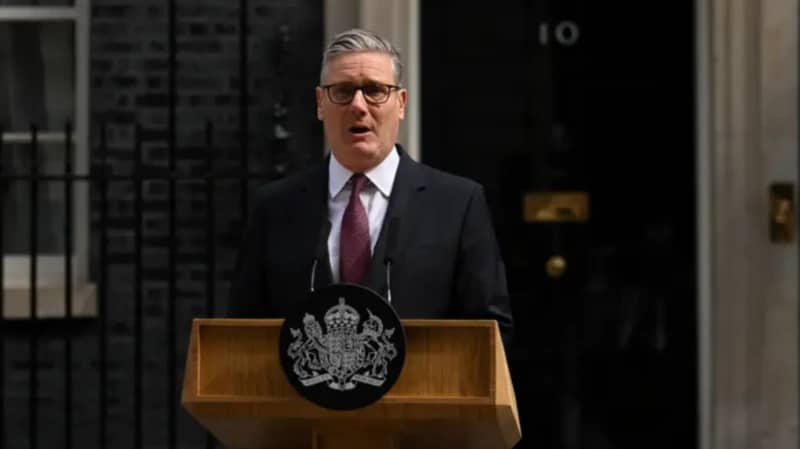 Starmer became Prime Minister on July 5, 2024, following a landslide victory by the Labour Party in the UK general election. In a broadcast on Monday morning, he revealed that he had informed King Charles III of his decision to step down.
However, Starmer will remain in office until the Labour Party completes the process of electing a new leader before Parliament returns from its summer recess in September.
According to Starmer, the Labour Party’s National Executive Committee will set out a timetable for the leadership election on July 9. Nominations for candidates will open on that date and close on July 16, with the entire process expected to be completed before Parliament reconvenes.
Reflecting on his time in office, Starmer described becoming Prime Minister as the proudest moment of his life.
“Walking into Downing Street two years ago was the proudest moment of my life,” he said.
Starmer also spoke about his desire to spend more time with his family after leaving what he described as the country’s biggest job.
“I want to be the best husband I can be to my wonderful wife, Victoria, who has stood by me through good times and bad. I also want to be the best father I can be to my children, who are my pride and joy,” he said.
The outgoing Prime Minister stated that his reason for entering politics was to improve the lives of millions of people. He said his government’s goal was never simply to hold power, but to build a fairer Britain where everyone is valued and where opportunities are available to all, not just a privileged few.
Starmer pledged to ensure a smooth and orderly transition of power and promised to give his successor his full support.
He also expressed confidence that the next leader would inherit a Britain that is stronger and fairer than it was two years ago.
Looking back on his leadership of the Labour Party, Starmer said he had taken over a party that was politically, financially, and morally weakened. He claimed that many people believed the party was beyond repair, but that he had proven them wrong.
According to Starmer, he helped rebuild Labour by tackling antisemitism within the party and restoring public trust in its economic, defence, and national security policies.
Pressure on Starmer to resign had been increasing for several months, particularly after Labour suffered heavy losses in local elections across England and Wales in May.
More than 150 Labour Members of Parliament reportedly called on him to step down after poor election results suggested that many voters had lost confidence in his leadership.
Labour lost nearly 1,500 council seats in local elections across England. Many voters shifted their support to the Reform UK Party, while the Green Party also gained support in London and other urban areas.
The party also lost power in Wales, where it had enjoyed political dominance for more than a century.
In Scotland, Labour secured only 17 of the 129 seats in the Scottish Parliament, marking its worst-ever performance in a Scottish parliamentary election.
Despite those setbacks, Starmer had previously insisted that his government had made the right political choices and vowed to prove critics wrong. However, he has now chosen to step aside and allow the Labour Party to select a new leader.

