South Africa president linked to covert operation to recover stolen cash, watchdog says

A declassified report by South Africa’s police watchdog risks reigniting one of the most politically damaging scandals of Cyril Ramaphosa’s presidency, linking him to an off-the-books operation to recover $580,000 stolen from inside a sofa at his game farm.
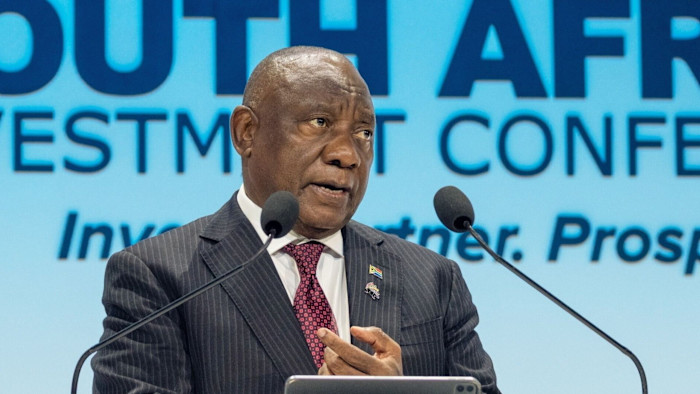
The report into the 2020 theft found that the president’s personal police officers operated outside formal legal channels in attempting to recover the money and keep the burglary at Ramaphosa’s Phala Phala game farm under wraps.
The head of Ramaphosa’s police security unit, Major General Wally Rhoode, participated in a cross-border operation to track down suspects and bypassed standard investigative procedures in an effort to “conceal” the crimes, according to the report by the Independent Police Investigative Directorate.
The IPID’s investigation found that Ramaphosa “instructed” Rhoode to travel to Namibia days after one of the burglary suspects was arrested in the neighbouring country.
The report was concluded in October 2023 but published this week by opposition party ActionSA and national news website News24 following lengthy legal battles and freedom-of-information requests.
“It’s clear that the African National Congress, in trying to protect Ramaphosa, has been taking us for fools,” Herman Mashaba, the leader of ActionSA, told the FT. “Given what this report shows, there’s no way the president can now say he didn’t know what happened with Phala Phala. We cannot allow ourselves to be led by people who are so compromised.”
Cyril Ramaphosa’s Phala Phala game farm © AP
A spokesperson for IPID confirmed that a redacted version of the report had been made public.
In a probe by South Africa’s public protector, Rhoode acknowledged making the trip but said it was undertaken so he could deliver sensitive security information to Namibia’s then-president.
But the IPID found that Rhoode and another officer had deliberately concealed the theft and used state resources to “investigate the president’s private business . . . in an attempt to track and bring back the president’s money without registering a case”.
In its most shocking findings, the report alleged that the suspects were kidnapped, interrogated and eventually bribed to keep quiet. The police watchdog recommended Rhoode and a colleague face disciplinary action, but none was taken.
While the IPID report stops short of directly implicating Ramaphosa, it points to blurred lines between his personal and official interests in the handling of the case.
Rhoode told News24 to direct all queries to the president’s office. The president has consistently denied wrongdoing.
Vincent Magwenya, a spokesperson for the presidency, told the FT that the public protector’s report did not find any evidence that “the president abused his power in utilising state resources by causing the [presidential protection service] members to be deployed at the Phala Phala Farm and to investigate the crime of housebreaking”.
Ramaphosa was first accused of a cover-up by Arthur Fraser, a spy chief under his predecessor and bitter rival Jacob Zuma. Many initially dismissed the outlandish claims of wads of cash hidden inside a sofa as the fantastical allegations of a Zuma acolyte.
But in December 2022, a damning parliamentary report concluded that Ramaphosa might have broken the law and should be investigated for possible impeachment.
As various probes unfolded, the president offered only sparse details, insisting the cash was from the sale of a herd of buffalo. He has also not addressed the alleged failure to disclose foreign earnings. The acting public protector cleared Ramaphosa of wrongdoing in 2023.
The latest report has come amid renewed pledges to root out corruption, particularly on the back of the 2024 general elections in which Ramaphosa continued as president but the ANC lost its majority for the first time amid widespread anger at political graft.
“In a context of widespread dysfunction and criminality within police, intelligence and military circles, this latest revelation will surprise few. The question now is if and how the relevant authorities act,” said Piers Pigou, a Johannesburg-based director of Intelwatch, which advocates for strengthening public oversight.
“Few will expect any expeditious route to accountability,” Pigou added. “Ramaphosa will likely absorb the further stain on his name by simply remaining silent.