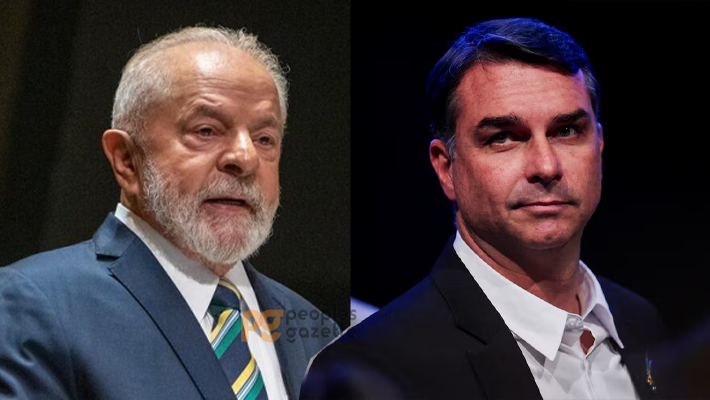

Brazilian President Luiz Inácio Lula da Silva has won re-election for an unprecedented fourth presidential term, defeating Senator Flávio Bolsonaro in a closely contested runoff election held on Sunday, October 25, 2026.
According to Brazil’s Superior Electoral Court, Lula secured 51.79 per cent of the valid votes, equivalent to approximately 64.26 million votes, while Bolsonaro received 48.21 per cent, or about 59.83 million votes.
The result gives Lula a margin of approximately 4.43 million votes, confirming his political comeback after finishing second to Bolsonaro in the first round of voting earlier in October.
Lula, 80, is set to begin his fourth non-consecutive presidential term on January 5, 2027, extending his record as one of Brazil’s most influential political leaders.
BOLSONARO REFUSES TO CONCEDE
Following the announcement of the results, Flávio Bolsonaro refused to concede defeat and said he would seek the annulment of the election.
Bolsonaro challenged a last-minute decision by Supreme Court Justice Cristiano Zanin to extend voting hours by two hours at polling stations that were still open. He described the decision as unacceptable and questioned the conduct of the election.
The extension followed requests from both presidential campaigns. Lula’s team cited transportation difficulties affecting voters in São Paulo and Salvador, while Bolsonaro’s campaign pointed to heavy rainfall in parts of southern Brazil.
The decision generated confusion at some polling stations and delayed the counting process. However, the electoral court confirmed Lula’s victory after the votes were counted.
LULA OVERCOMES FIRST-ROUND DEFEAT
Lula’s victory marks a significant turnaround in a highly competitive election. Bolsonaro had finished ahead in the first round, securing approximately 47 per cent of the vote compared with Lula’s 45 per cent.
The president subsequently reorganised his campaign, mobilised supporters and appealed to undecided voters, emphasising democratic values, social welfare and his administration’s record.
The election campaign was dominated by concerns about the cost of living, public security, corruption allegations and the country’s economic future.
While Bolsonaro campaigned on a tough-on-crime platform and promised measures to reduce food prices, Lula sought to defend his social programmes and maintain support among working-class voters.
POLITICAL IMPLICATIONS OF LULA’S VICTORY
Lula’s re-election is expected to maintain Brazil’s left-leaning political direction and influence the country’s economic and diplomatic priorities.
As Latin America’s largest economy, Brazil plays a significant role in regional trade, environmental policy and international relations.
Lula has frequently emphasised national sovereignty and opposed what he considers excessive foreign influence in Latin American affairs. His victory is therefore expected to shape Brazil’s relationship with the United States and other major international partners.
The election also highlights the continuing political division between supporters of Lula’s Workers’ Party and the right-wing movement associated with the Bolsonaro family.
Lula previously served as president from 2003 to 2010 before returning to office in January 2023 following his victory in the 2022 election.
His latest victory makes him the first Brazilian president to win four presidential elections through direct voting, having won in 2002, 2006, 2022 and 2026.
Despite the challenge from Bolsonaro, the electoral court’s announcement confirmed Lula as the winner of the 2026 presidential runoff, setting the stage for another four years of his leadership.