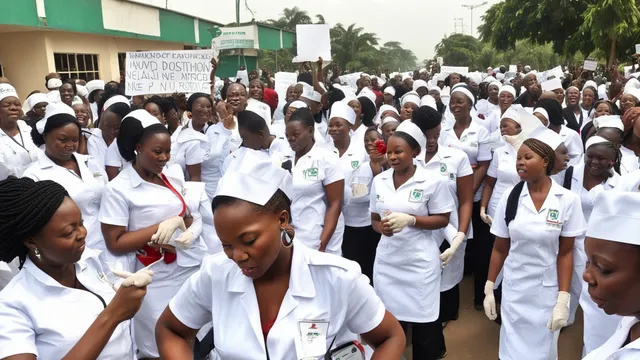

The National Association of Nigerian Nurses and Midwives (NANNM) has suspended its nationwide warning strike, four days after it commenced the strike over poor welfare, stagnated allowances, and staffing shortages, among others.

The strike was suspended on Saturday following a virtual meeting of NANNM’s National Executive Council (NEC).
The decision comes after negotiations with the Federal Ministry of Health and Social Welfare, the Office of the Head of Service, the Ministry of Labour and Employment, the Office of the Accountant General, the National Salaries and Wages Commission, and other relevant stakeholders to address its members’ demands.
The Assistant Secretary-General of the association, Chidi Aligwe, confirmed the suspension to the press on Saturday, saying, “The strike has been suspended. Nurses and midwives are to resume duty immediately.”
Resolution
A circular signed by NANNM’s National President, Haruna Mamman, and General Secretary, T.A. Shettima, stated that NEC resolved to suspend the action after an extensive review of the Memorandum of Understanding and the agreed time-bound implementation framework.
The circular added that the federal government had shown commitment to addressing the association’s nine-point demands, which include upward review of shift and uniform allowances, a new salary structure for nurses, increased core duty allowance, mass recruitment, and the establishment of a Department of Nursing Services within the Federal Ministry of Health.
Audience Feedback Survey
“In view of the formal agreement reached, and in line with the principle of dialogue and good faith, NEC hereby suspends the ongoing nationwide strike action with immediate effect,” the circular read.
NEC also directed all state chapters to mobilise members for immediate resumption and cautioned against any form of victimisation of striking nurses, including interns and locum staff.
It reiterated NANNM’s commitment to defending the welfare and professional dignity of nurses and midwives across the country.
Strike impact, field observations
The seven-day warning strike, which began on 29 July, was declared by the NANNM-Federal Health Institutions Sector (NANNM-FHI) after the federal government failed to act on a 15-day ultimatum issued on 14 July.
During the week, PREMIUM TIMES visited several public hospitals in Abuja and Lagos to assess the impact of the strike. Across multiple facilities, outpatient units were shut, with reports of cancelled or rescheduled appointments, and patients turned away due to reduced staffing. Nigerian hospitals struggle to cope as nurses’ strike enters fourth day
In some hospitals, nurses who remained on duty said they were only attending to critical cases, while others relied on temporary staff to manage basic services.
Patients expressed frustration over the disruptions and uncertainty surrounding their healthcare.