
Nigerian Student Builds 12-Meter Helicopter from Scrap Parts Without an Engineering Degree

Nigerian Student Builds 12-Meter Helicopter from Scrap Parts Without an Engineering Degree
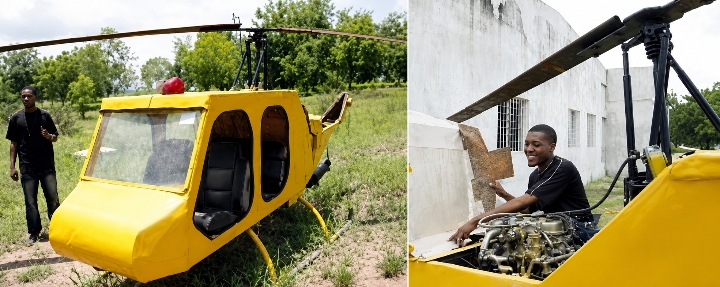
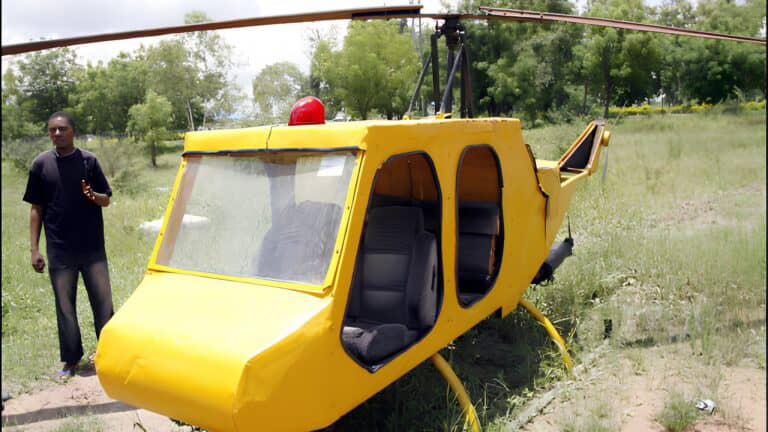 In 2007, a 24-year-old Nigerian physics student, Mubarak Muhammad Abdullahi of Bayero University, Kano, amazed many people by designing and building a 12-meter helicopter in his backyard using salvaged vehicle and aircraft parts despite having no formal engineering degree.
Over eight months, Abdullahi gathered parts from old cars, motorcycles, and even fragments of a crashed Boeing 747. He funded much of the project himself through earnings from repairing computers and mobile phones, while his father helped purchase aluminum and other essential materials.
The helicopter was powered by a 133-horsepower Honda Civic engine, featured Toyota seats, and included a basic cockpit with an ignition switch, throttle lever, joystick, radio transmitter, and a camera mounted underneath to assist with ground visibility.
Inspired by his love of action movies and knowledge gained from internet research, Abdullahi successfully completed six short test flights. Although the aircraft only reached about two meters (seven feet) above the ground, it proved that the homemade machine could lift off and fly briefly.
He openly acknowledged that the prototype lacked advanced flight instruments needed to measure altitude, atmospheric pressure, and other important flight data. Nevertheless, the achievement demonstrated remarkable creativity, determination, and practical application of physics.
Despite attracting widespread attention, Abdullahi expressed disappointment over the lack of support from Nigeria’s aviation authorities. He believed that with proper technical guidance and funding, his invention could be significantly improved.
Rather than stopping after the first success, Abdullahi began work on a second, more advanced helicopter. His goal was to build a two-seater aircraft capable of flying up to 4.5 meters high and remaining airborne for as long as three hours.
His story continues to inspire many as an example of innovation, resilience, and the extraordinary potential of young African inventors when given the opportunity to develop their talents.
