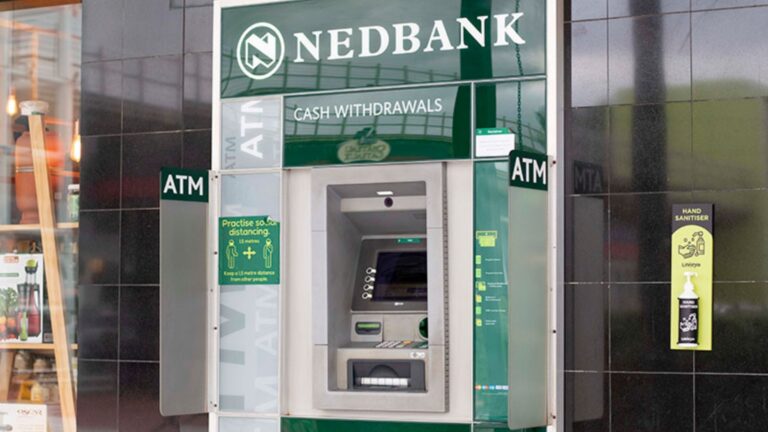

Nedbank has reduced its ATM footprint in South Africa by nearly 250 devices over the past five years, and has also started reducing its cash-accepting ATM numbers over the past two years.
 The bank reported its South African branch, ATM, and cash-accepting ATM numbers in its annual results. After a period of increasing these numbers, it is now “rightsizing” these networks.
While it had three more branches in South Africa at the end of December 2025 than at the same point in 2021, its current figure of 541 branches is down from its 2023 peak of 547.
In its latest annual results, for the year ended 31 December 2025, it said clients’ access to banking products and services continued to grow.This has been the primary driver of its ATM and branch reductions in recent years, as the bank has observed a fundamental shift in client behaviour and preferences towards digital channels.
The bank also highlighted its plans to rationalise its physical points of presence in its earlier annual reports.
“We continue to optimise our integrated physical distribution as clients shift their behaviour towards digital channels,” Nedbank said in its annual report for the year ended 31 December 2024.
The bank’s reporting for the past five financial years showed that its ATM network has faced the most significant reductions.It had 4,251 ATMs as of 31 December 2021, and this figure rose to 4,334 by the same date in 2022. However, this was when Nedbank started reducing its physical footprint.
The bank shuttered 135 ATMs in South Africa between 31 December 2022 and 31 December 2023, followed by a further 94 in 2024, and 91 in 2025. Its ATM numbers dropped by 247 over the five years.
Nedbank’s network of cash-accepting ATMs had seen an increase over the past five years. It had 1,278 as of 31 December 2021, and its network peaked at 1,350 by 31 December 2023.
However, the bank started reducing its deposit-taking ATMs in 2024. Its network was reduced to 1,324 by 31 December 2024, and to 1,308 by 31 December 2025. Nedbank grew its branch network from 538 to 547 between 31 December 2021 and the same point in 2023.
However, reductions followed in 2024 and 2025. The bank now has 541 branches in South Africa.
Nedbank’s branch, ATM, and cash-accepting ATM changes for the past five financial years are summarised in the table below.Year Branches ATMs Cash-accepting ATMs
2021 538 4,261 1,278
2022 545 4,334 1,328
2023 547 4,199 1,350
2024 543 4,105 1,324
2025 541 4,014 1,308
Five-year change +3 -247 +30
New strategy proposed for ATMs in South Africa
The South African Reserve Bank (SARB) recently published its Position Paper on Cash in South Africa, in which it proposed a significant change for ATMs in the country.
The SARB proposed a new strategy that could see banks’ ATMs replaced by white-label devices, following the reduction of banks’ ATM footprints across the country.
The white-label ATMs would be independently owned and not tied to a specific bank. This would enable customers from any bank to withdraw cash and transact.
This forms part of its Cash Smart strategy, which also aims to expand access to cash through a national cash utility.
However, it should be noted that the Position Paper on Cash doesn’t set binding regulations. Instead, it provides a policy rationale to guide the development of regulations.
“White-label ATMs are recognised under the Cash Smart strategy as an important access mechanism for sustaining cash availability, particularly as bank-owned ATM infrastructure is rationalised,” the SARB said.
“White-label ATMs are envisaged as part of a utility-coordinated access layer that facilitates geographic rebalancing, improves reach in underserved areas, and reduces time and travel costs.”
It said it would develop a regulatory framework and supporting instruments to provide for deployment, funding, and operational arrangements.
The SARB stated that while digital payments were growing, cash remained essential for more than two-thirds of transactions in South Africa, particularly in rural areas and informal markets.
It added that bank branches remained essential for high-value transactions and deposits, but noted that they were less efficient than ATMs.
“ATMs, especially those operated by banks, are a more cost-effective channel for cash transactions, as opposed to bank branches,” the SARB said