
Total Solaris Eclipse Draws Millions As Spain and Iceland fall into Darkness

Millions of skywatchers across Europe were treated to a spectacular total solar eclipse on Wednesday, August 12, 2026, as the Moon completely blocked the Sun in parts of Spain and Iceland, creating a dramatic display of darkness in the middle of the day.
 The rare celestial event swept across a path stretching from northern Russia through Greenland and Iceland before crossing the Atlantic and reaching Spain and a small part of Portugal. NASA confirmed that totality was visible along this path, while much of Europe and parts of North America and Africa experienced a partial eclipse.
During the period of totality, the Moon moved directly between Earth and the Sun, covering the bright solar disk and revealing the Sun’s outer atmosphere, known as the corona.
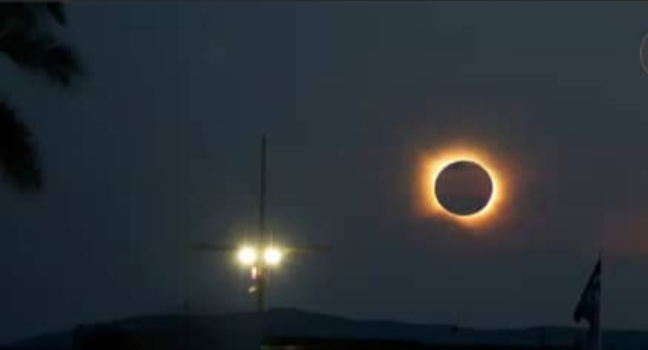
The resulting spectacle produced striking images of a dark Moon surrounded by a glowing ring of sunlight.
Spain offered some of the best viewing opportunities in Europe, with the path of totality crossing the country from west to east.
The European Space Agency said Spain experienced the largest area of totality in Europe, attracting large numbers of spectators and astronomy enthusiasts.
Iceland also had a front-row view of the eclipse, although changing weather conditions made clear skies an important factor for observers.
Across both countries, people gathered at viewing locations to witness the rare astronomical event and capture photographs and videos of the moment the daytime sky dramatically darkened.
The eclipse generated widespread excitement, with crowds gathering at observatories, parks, coastal locations and other viewing sites. In areas outside the path of totality, observers could still see the Moon covering a significant portion of the Sun during the partial eclipse.
The spectacular images circulating online, including footage from Spain and Iceland, captured the Moon’s silhouette against the Sun and the glowing solar corona around it.
For scientists and astronomy enthusiasts, the event was more than a visual spectacle.
A total solar eclipse provides a rare opportunity to observe the Sun’s corona, which is normally difficult to see because the much brighter solar surface overwhelms it.
The August 12 eclipse was therefore both a scientific opportunity and a memorable experience for millions of people who watched the skies across Europe and beyond.

