US withholds visa for Sudan army chief ahead of UNGA over opposition to US-backed 90-day ceasefire plan in war that has killed thousands

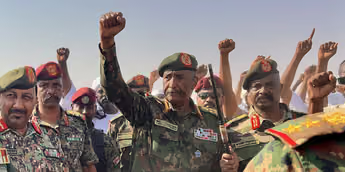
The United States is withholding a visa for Sudanese army chief Abdel Fattah al-Burhan ahead of his planned appearance at the UN General Assembly, with Sudanese and other sources linking the move to Khartoum’s resistance to a US-backed ceasefire plan.
 Burhan was scheduled to address the General Assembly in New York on Thursday, but a senior Sudanese source said he had postponed the trip after failing to receive a visa. Foreign Minister Mohieldin Salem is expected to address the gathering instead.
According to Reuters, US officials have made Burhan’s attendance conditional on accepting a 90-day ceasefire proposed by Massad Boulos, Washington’s senior adviser for Arab and African affairs.Sudan resists US ceasefire plan
The Sudanese army has raised objections to the proposal, particularly over the withdrawal of the paramilitary Rapid Support Forces, or RSF, from areas it controls.
The US plan, presented in June, called for an immediate 90-day humanitarian truce, followed by negotiations towards a permanent ceasefire and a civilian-led transition.
However, the army has demanded that the RSF withdraw from all cities it has occupied since May 2023, rather than the more limited withdrawals proposed under the US plan.
Burhan has also rejected what Sudanese officials describe as a take-it-or-leave-it approach, arguing that previous pauses in fighting allowed the RSF to regroup.How the peace efforts reached this point
The war began on April 15, 2023, when tensions between Burhan’s Sudanese Armed Forces and the RSF, led by Mohamed Hamdan Dagalo, widely known as Hemedti, erupted into fighting.
In May 2023, the United States and Saudi Arabia brought the two sides to Jeddah for ceasefire talks. Several temporary truces followed but failed to hold.
Washington convened another round of talks in Switzerland in August 2024, although the Sudanese army did not attend. The US also expanded its mediation efforts through a four-country group with Saudi Arabia, Egypt and the United Arab Emirates. By June 2026, Washington had presented the latest 90-day proposal. Sudan’s army accepted parts of the plan but maintained its demand for a full RSF withdrawal from occupied cities.
The disagreement reached the UN in September as Burhan prepared to travel to New York. On September 21, Sudan formally asked the United Nations to intervene after his visa had not been issued.
Sudan asks UN to intervene
In a letter to UN Secretary-General Antonio Guterres, Sudan’s UN Ambassador Al-Harith Idriss Al-Harith warned that the visa dispute could prevent the head of a UN member state from attending the General Assembly.
“Should this situation persist, it would effectively prevent the Head of State of a Member State of the United Nations from participating in person in the work of the General Assembly,” the letter said.UN spokesperson Stéphane Dujarric said Guterres was “deeply concerned” that Burhan’s visa had reportedly not been issued and was engaging US authorities over the matter.
The dispute also raises questions over Washington’s obligations as host of the UN headquarters in New York, where the United States is generally required to facilitate entry for representatives of member states.
Burhan has addressed previous General Assembly meetings despite the African Union and Western powers withdrawing recognition after the 2021 military takeover he led alongside Hemedti.