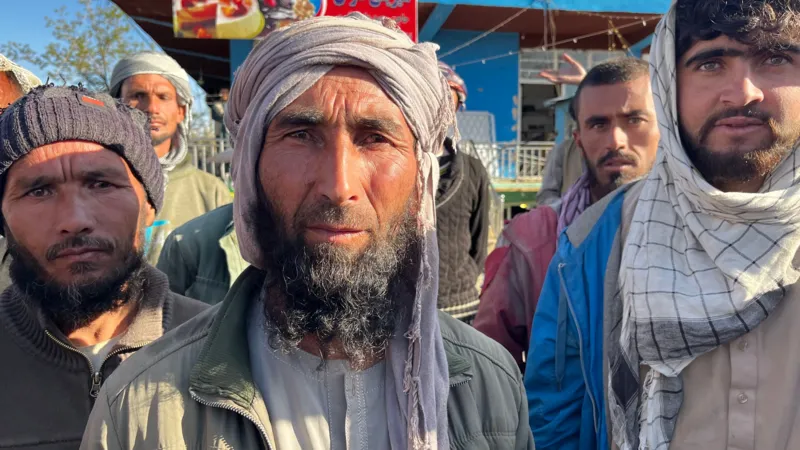

As dawn breaks, hundreds of men gather at a dusty square in Chaghcharan, the capital of Ghor province in Afghanistan. They line the roadside with weary faces, hoping someone will come along offering any work. It will determine whether their families eat that day.
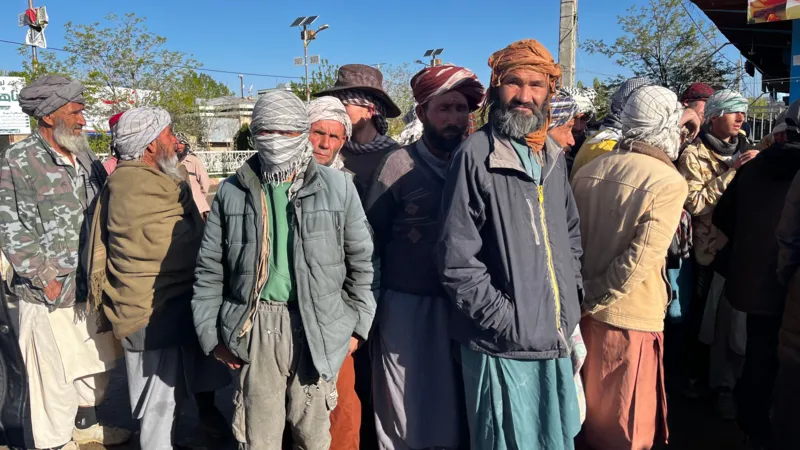 The likelihood of success, however, is low.
Juma Khan, 45, has found just three days of work in the past six weeks that paid between 150 to 200 Afghani ($2.35-$3.13; £1.76-£2.34) per day.
“My children went to bed hungry three nights in a row. My wife was crying, so were my children. So I begged a neighbour for some money to buy flour,” he says.
“I live in fear that my children will die of hunger.”
His story is in no way unique. In Afghanistan today, a staggering three in four people cannot meet their basic needs, according to the United Nations. Unemployment is rife, healthcare struggling and the aid that once provided the basics for millions has dwindled to a fraction of what it once was. Khwaja Ahmad barely gets out a few words before he starts sobbing.
“We are starving. My older children died, so I need to work to feed my family. But I’m old, so no one wants to give me work,” he says.
When a local bakery near the square opens up, the owner distributes stale bread among the crowd. Within seconds, the loaves have been pulled apart, half a dozen men clutching onto precious pieces.
Suddenly another scrum occurs. A man on a motorcycle comes by wanting to hire one labourer to carry bricks. Dozens of men throw themselves at him.
In the two hours we were there, only three men got hired.In the communities nearby – bare homes scattered over barren, brown hills, set against the snowy peaks of the Siah Koh mountain range – the devastating impact of unemployment is clear.
Abdul Rashid Azimi takes us into his home and brings out two of his children – seven-year-old twins Roqia and Rohila. He holds them close, eager to explain why he’s making unbearable choices.
“I’m willing to sell my daughters,” he weeps. “I’m poor, in debt and helpless.
“I come home from work with parched lips, hungry, thirsty, distressed and confused. My children come to me saying ‘Baba, give us some bread’. But what can I give? Where is the work?”Abdul tells us he is willing to sell his girls for marriage, or for domestic work. “If I sell one daughter, I could feed the rest of my children for at least four years,” he says.
He hugs Rohila, kissing her as he cries. “It breaks my heart, but it’s the only way.”
All we have to eat is bread and hot water, not even tea,” says their mother, Kayhan.
The choice to sell daughters over sons, is because culturally sons are widely seen as future breadwinners, and here in Afghanistan, with the Taliban’s restrictions on education and work for women and girls, it is even more pronounced.
Additionally, there is a tradition in which a marital gift is given to the family of the girl from the family of the boy during marriage.Two of Abdul and Kayhan’s teenage sons work polishing shoes in the town centre. Another collects rubbish, which Kayhan uses as fuel for cooking.
Saeed Ahmad tells us he has already been forced to sell his five-year-old daughter, Shaiqa, after she got appendicitis and a cyst in her liver.
“I had no money to pay the medical expenses. So I sold my daughter to a relative,” he says.
Shaiqa’s surgery was successful. The money for it came from the 200,000 Afghani ($3,200; £2,400) she has been sold for.
“If I had taken the whole sum at that time, he would have taken her away. So I told him just give me enough for her treatment now, and in the next five years you can give me the rest after which you can take her. She will become his daughter-in-law,” explains Saeed.
Shaiqa puts her tiny arms around his neck. Their close bond is evident, but in five years, when she is just 10, she will have to leave and go to the relative’s home to marry one of his sons.
“If I had money, I would never have taken this decision,” Saeed says. “But then I thought, what if she dies without the surgery?
“Giving away your child at such a young age, carries a lot of anxiety. Underage [marriages] have their problems; however, because I couldn’t pay for her treatment, I was thinking, at least she will be alive.”
The practice of underage marriage remains widespread in Afghanistan and is increasing due to the Taliban government’s bar on education for girls.Just two years ago, Saeed was getting some help.
Back then, he and his family – like millions of other Afghans – received food aid: flour, cooking oil, lentils and supplements for children.
But massive cuts in aid over the past few years have deprived a large majority of this life-saving assistance.
The US – once the top donor to Afghanistan – cut nearly all aid to the country last year. Many other key donors have also significantly reduced contributions, including the UK. Current UN figures show that the aid received so far this year is 70% lower than in 2025.
A nurse wheels in a small cot with newborn twin girls. They’re two months premature. One weighs 2kg, the other just 1kg.
They’re in a critical condition and were immediately put on oxygen.
Their mother, 22-year-old Shakila, is recovering in the maternity ward.
“She is weak because she had barely anything to eat when she was carrying them, just bread and tea,” the twins’ grandmother Gulbadan explains. “That’s why the babies are in such a condition.”
A few hours after we left the hospital that day, the heavier baby died before she could even be named.
“The doctors tried to help her but she died,” her stricken grandmother says the next day.I wrapped her tiny body up and took her home. When her mother found out, she fainted.”
Gulbadan points to the surviving baby, adding: “I hope she at least survives.”Nurse Fatima Husseini says there are days when as many as three babies die.
“In the beginning, I found it very hard when I saw children dying. But now it has almost become normal for us,” she says.
Dr Muhammad Mosa Oldat, who runs the neonatal unit, says the mortality rate climbs as high as 10%, which is “not acceptable”.
“But because of poverty, the patient load is increasing every day,” he says. “And here we also don’t have the resources to treat the babies properly.”