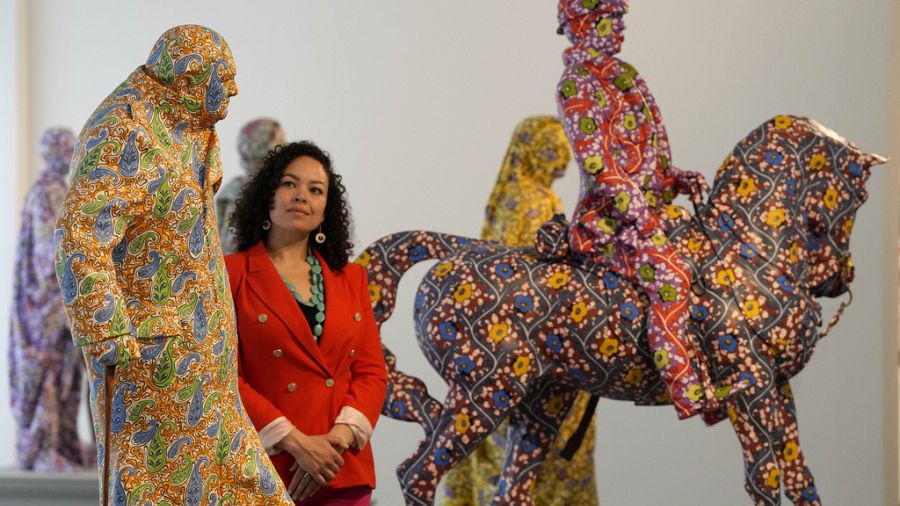

 People are talking about the idea of actually knocking statues down because of the colonial history of those figures. And I felt that actually the best approach is not to actually knock them down, in the same way that you wouldn’t go into a library and start burning the books you didn’t like, you know?” he says.
“So I thought that it’s actually better to preserve history and for people to actually understand what people did, what Queen Victoria did, what Churchill did. And my approach really is to actually improve them, to make them more beautiful.”
“People are complex”
The vibrant statues are part of a new exhibition opening in London.
The British artist spent much of his childhood in Nigeria, and his art often explores the tangled colonial relationships between Africa and Europe.
But he’s balanced in his judgement of past leaders and the decisions they made.
“I think human beings are very complicated. No one is just a villain or no one is just good. And I think that’s what’s very important about those debates because people are very complex. And also, somebody who lived in the 19th century is not the same as the person living today. And you can’t really conflate ideas or the values of the 19th century with our values. We are different people. So it’s important that we understand them in the context in which they existed,” says Shonibare.
The importance of memory
A highlight of the exhibition is ‘The War Library’, an installation of more than 5,000 books about conflicts.
There are peace treaties bound in printed cotton, covering countries in Africa, Europe, the Middle East, Asia and beyond.
There are even volumes on the shelves with no titles at all – symbolising deadly conflicts that have not yet happened, but are inevitable.