
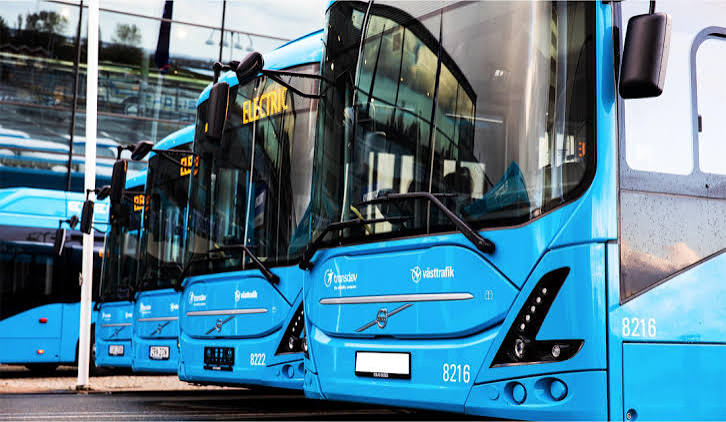
FG deploys electric buses to cut transport burden on civil servants

The Federal Government has begun deploying 100 electric mass transit buses for federal civil servants, aiming to reduce the rising cost of daily transportation and improve workers’ welfare and productivity.
 The first batch of 37 buses was commissioned on Wednesday at Eagle Square, Abuja, by the Head of the Civil Service of the Federation (HCSF), Mrs. Didi Esther Walson-Jack, OON, mni, as part of the Federal Civil Service Electric Mass Transit Programme.
The initiative, approved by the Federal Executive Council under the Renewed Hope Mass Transit Scheme, is designed to provide federal workers with safer, more affordable and reliable transportation along designated routes within the Federal Capital Territory.
Speaking at the commissioning, Walson-Jack described the intervention as a practical demonstration of the Federal Government’s commitment to the welfare of its workforce, saying transportation was central to the productivity and wellbeing of civil servants.
“For many civil servants, the daily commute shapes their finances, their safety, their punctuality and ultimately their productivity,” she said.According to her, the intervention would ease workers’ transportation costs, improve punctuality, and provide a safer way to commute to and from work.
Walson-Jack, who is due to leave office as Head of Service, described the commissioning as a fitting parting gift to federal civil servants.
She said, “This commissioning is providentially my parting gift to my dearly beloved federal servants. In a little under 24 hours, my time as Head of the Civil Service of the Federation comes to an end.
I could not have asked for a more fitting note on which to close this chapter of service than receiving and handing over the keys to something that will keep moving, keep working long after I have gone home.”
She said the acquisition of the buses was made possible through the Renewed Hope Infrastructure Development Fund, adding that the intervention demonstrated President Bola Ahmed Tinubu’s commitment to translating the Renewed Hope Agenda into practical benefits for workers.
Walson-Jack also linked the transport initiative to other Federal Government interventions, including the upward review of the national minimum wage, the wage award following the removal of the fuel subsidy, digitalisation of the public service, and renewed attention to pensions, promotions, employee compensation, and health insurance.
“Each is a thread in the same commitment that reform must be felt, not merely announced,” she said.
Also speaking, the Minister of State for Industry, Senator John Owan Enoh, said the programme was not merely about providing buses but represented an investment in workers’ welfare, productivity and local industrial development.
Enoh said the 100 electric buses, when fully deployed, would provide dedicated mass transit for federal civil servants and help reduce transportation costs on workers’ household incomes.
He said each bus could accommodate up to 200 passengers and travel at least 200 kilometres on a full charge.
The minister said the intervention reflected President Tinubu’s position that economic reforms must ultimately produce tangible improvements in the lives of Nigerians.
Enoh said the 100 electric buses, when fully deployed, would provide dedicated mass transit for federal civil servants and help reduce transportation costs on workers’ household incomes.
He said each bus could accommodate up to 200 passengers and travel at least 200 kilometres on a full charge.
The minister said the intervention reflected President Tinubu’s position that economic reforms must ultimately produce tangible improvements in the lives of Nigerians. He said the initiative would also contribute to the development of Nigeria’s automotive sector and broader industrialisation efforts. NigerianTravel Guide
The buses, approved by the National Automotive Design and Development Council (NADDC), are expected to operate on designated routes linking major residential corridors with the Federal Secretariat and other government offices in the FCT.
The first deployment is expected to serve as an operational phase to test the scheme and establish the framework for its wider rollout across the federal public service.Walson-Jack expressed appreciation to President Tinubu for his support for civil servants and commended the Minister of State for Industry, as well as permanent secretaries and officials whose collaboration helped implement the programme.
She emphasised that welfare should remain central to public service reform, noting that a supported and motivated workforce would be better positioned to deliver quality services to Nigerians.
