

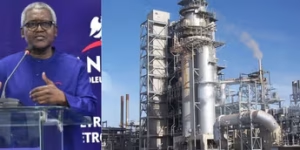
Nigeria is home to the world’s largest single-train crude oil refinery—but there’s a problem

Nigeria’s oil industry is entering a new phase. The country’s biggest challenge is no longer a lack of refining capacity but producing enough crude oil to supply its refineries.As domestic refining expands, Nigeria must balance crude supplies for local processors, export commitments, and crude-backed loan agreements.
Math behind the crude oil deficit
At an estimated 85% operating capacity, the Dangote Petroleum Refinery needs about 552,500 barrels of crude oil per day. That is roughly 35% of Nigeria’s total daily crude production.Nigeria produced 1.56 million barrels per day in June. After supplying the Dangote refinery, about 1.01 million barrels per day remains for smaller domestic refineries, export commitments, and crude-backed financing deals.
While that is enough under normal conditions, it leaves little room for unexpected disruptions such as pipeline failures, production outages, or security incidents in the Niger Delta.
According to Punch, records from May and June 2026 show that the Dangote refinery sourced only 78% of its crude oil supply from the Nigerian National Petroleum Company (NNPC). The remaining 22% was imported from other countries.
Pressure on local crude oil refinersNigeria’s challenge is not a shortage of oil reserves. The country holds an estimated 37.28 billion barrels of crude oil and condensate. The immediate issue is producing enough oil each day to meet rising demand. With Nigeria’s downstream fuel market largely deregulated, fuel prices are now more closely tied to production costs and exchange rate movements.
As a result, any disruption in crude supply can quickly push up pump prices.
A report by Lagos-based research firm PAC Research, cited by BusinessDay, said:The firm added that the interaction between these structural pressures will shape fuel pricing, foreign exchange demand, inflation, and investor confidence over the next 12 to 18 months.
