
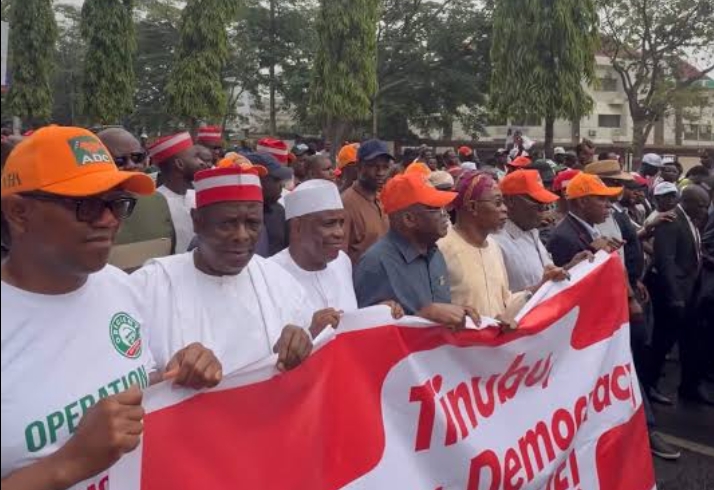
Obi, Atiku, Kwankwaso lead mass protest demanding “Tinubu Let Our Democracy Breathe”

Obi, Atiku, Kwankwaso lead mass protest demanding “Tinubu Let Our Democracy Breathe”
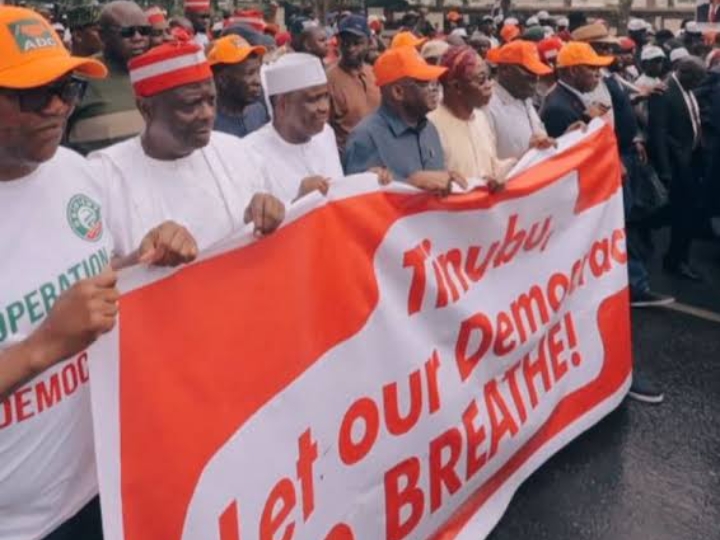
Opposition leaders Obi, Atiku, Kwankwaso march through Abuja with democracy banners “Tinubu Let Our Democracy Breathe” as thousands chant, “Tinubu Must ‘Go.’”
Thousands of demonstrators flooded the streets of Abuja on Wednesday as former presidential candidates Peter Obi and Rabiu Kwankwaso jointly led a sweeping mass protest against President Bola Tinubu’s administration, carrying a banner reading “Tinubu Let Out Democracy Breath” while crowds roared “Tinubu Must Go” behind them.
The demonstration, which drew participants from across multiple states, marks one of the most visible and organized opposition-led street protests since Tinubu assumed the presidency in May 2023. Security forces were deployed around the Federal Capital Territory as the march moved through key arterial roads toward the National Assembly.
Obi, the Labour Party’s 2023 presidential candidate who narrowly contested the election results in court, addressed the crowd directly. “Democracy is not a gift handed to citizens,” he said. “It is a right we must defend in the open, with our feet, our voices, and our presence on these streets.”A united opposition front
The sight of Obi and Kwankwaso marching together represents a significant symbolic alignment. The two leaders ran as rivals in the 2023 general election — Obi for Labour Party and Kwankwaso under the New Nigeria Peoples Party — but have since found common ground in opposing what they call democratic backsliding under the current administration.
“Nigeria’s democracy is suffocating. When the people can no longer speak through the ballot, they must speak through the boulevard. We are here, and we are not leaving until our voices register.”
— Rabiu Kwankwaso, NNPP Presidential Candidate, 2023
Wednesday’s protest builds on months of growing public discontent. Nigerians have endured soaring inflation exceeding 31 percent, fuel subsidy removal fallout, and a weakened naira that has eroded purchasing power for millions of working-class and middle-income households.
Government yet to respond
As of press time, the Presidency had not issued a formal statement responding to the protest. Government spokespersons were unavailable for immediate comment, though sources within the ruling All Progressives Congress described the demonstration as “politically motivated theatre ahead of the 2027 cycle.”
Civil society groups, however, cautioned against dismissing the march. A spokesperson for the Transition Monitoring Group, a leading democracy watchdog, stated that the scale of the turnout deserved serious governmental attention.
“When former candidates become protest leaders, it signals that institutional channels of dissent are no longer trusted,” she noted.
“This is not just about one administration. It is about whether Nigerian citizens retain the right to hold power accountable between elections. That right must never be negotiated away.”
— Civil Society Spokesperson, Transition Monitoring Group
What comes next
Protest organizers say Wednesday’s march is only an opening act. A communiqué issued before the demonstration outlined plans for nationwide rallies across Lagos, Kano, Enugu, and Port Harcourt over the coming weeks. The coalition is also calling on the National Assembly to convene an emergency session to address economic hardship and what it terms a “democratic deficit.”
With the 2027 general elections on the horizon, Wednesday’s protest is likely to redefine coalition dynamics within Nigeria’s fractured opposition—and test how far public anger can translate into organised electoral force. For now, the streets of Abuja have delivered an unmistakable message: Nigerians are watching, mobilising, and making themselves heard.

